Loading... Please wait...

Categories
New Products

Our Newsletter
- Home
- UV Measurement
- Jelight J-225 Shortwave UV Intensity Meter
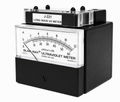
Jelight J-225 Shortwave UV Intensity Meter


Product Description
Jelight J-225
is a compact, self-powered analog UV intensity meter designed to measure shortwave ultraviolet irradiance with peak sensitivity at 254 nm. Featuring two measurement scales and a detachable sensor, it supports germicidal lamp monitoring, shortwave filter evaluation, and laboratory quality-control applications.
Applications
Germicidal UV Lamp Performance Monitoring
Measures shortwave UV irradiance to monitor germicidal lamp performance and identify output degradation over time. Consistent sensor placement enables comparative measurements of lamp condition.
Shortwave UV Filter Evaluation
Measures UV-C transmission through shortwave lamp filters to monitor deterioration caused by prolonged use. Comparing readings against an initial reference helps assess changes in filter performance.
Laboratory UV-C Intensity Verification
Supports UV-C irradiance measurements at laboratory work surfaces and designated exposure positions. Repeatable readings help verify lamp output during routine inspection and quality-control procedures.
Features
- Two selectable analog measurement scales accommodate low- and higher-intensity UV-C sources.
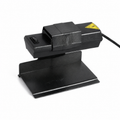
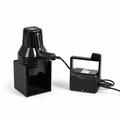
- Detachable sensor with a 1.2 m (4 ft) extension cord supports remote irradiance measurements.
- Self-powered photovoltaic operation eliminates the need for batteries or external power.
- Included contrast filter enables correction of infrared interference when measuring suitable UV sources.
- Approximately 5X attenuation screen permits relative measurements of high-intensity UV lamps beyond the normal scale.
- Individually serialized meter and sensor provide traceability to NIST-referenced calibration standards.
Specifications
| Instrument Type | Analog UV Intensity Meter |
| Primary Measurement Wavelength | 254 nm (UV-C / Shortwave) |
| Sensor Spectral Range | 220–280 nm |
| Sensor Peak Sensitivity | 254 nm |
| Measurement Range — A Scale | 0–2,400 µW/cm² |
| Measurement Range — B Scale | 2,000–12,000 µW/cm² |
| Minimum Detector Limit | 20 µW/cm² |
| Display | Analog, Dual-Scale |
| Sensor Configuration | Detachable, Remote-Capable |
| Sensor Cable Length | 1.2 m (4 ft) |
| Power Source | Self-Powered Photovoltaic |
| Dimensions | 76 × 76 × 76 mm (3 × 3 × 3 in) |
| Weight | 0.25 kg (9 oz) |
Documentation
Frequently Asked Questions
How can I use the J-225 to monitor deterioration of germicidal UV tubes?
Attach the perforated reduction screen and position the sensor directly against the tube, taking readings approximately 10 cm (4 in) from each end and another at the center. Average the three readings and compare them with previous measurements taken under identical conditions. Always use appropriate UV-protective eyewear and clothing when measuring exposed UV-C sources.
Can the J-225 detect deterioration in shortwave UV lamp filters?
Yes, the J-225 can evaluate changes in shortwave UV filter transmission by comparing current measurements against an initial reference taken with a new filter. Measurements of the exposed lamp tube can help distinguish reduced lamp output from filter deterioration.
Can prolonged UV-C exposure affect the J-225 sensor?
Yes, prolonged exposure to shortwave UV radiation can deteriorate the sensor's optical filter and affect calibration accuracy. Expose the sensor only long enough to obtain a reading, particularly when measuring high-intensity UV-C sources.
Can the J-225 measure irradiance above 12,000 µW/cm²?
The included reduction screen permits relative measurements of UV sources exceeding the normal B-scale range. Its attenuation is approximately 5X, but readings taken with the screen are not calibrated absolute irradiance measurements.
How often should the J-225 be recalibrated?
The manufacturer recommends recalibration at least every six months to maintain measurement accuracy and calibration traceability. Contact ScienceLighting for assistance with current calibration-service arrangements.
Warranty
This product is covered by a 12-month warranty against defects in materials and workmanship. Inspect the product before use and contact ScienceLighting support if any defects or issues are identified.
Ordering
Have additional questions? Contact ScienceLighting at (650) 961-9031 or sales@sciencelighting.com.
Warranty Information

Currency Converter
Choose a currency below to display product prices in the selected currency.
-
 US Dollar
-
 EURO - EUROPEAN UNION
-
 JPY -JAPAN YEN
-
 CAD - CANADA
-
 INR - INDIA
-
 CNY - CHINA
-
 MXN - MEXICO
-
 GBP - GREAT BRITAIN
-
 SGD - SINGAPORE
-
 KRW - SOUTH KOREAN REPUBLIC
-
 AUD - AUSTRALIA
-
 SAR - SAUDI ARABIA
-
 ZAR - SOUTH AFRICAs
-
 CHF - SWITZERLAND
-
 ARA - ARGENTINA
-
 BRL - BRAZIL
-
 CLP - CHILE
-
 COP - COLOMBIA
-
 DKK - DENMARK
-
 IDR - INDONESIA
-
 NOK - NORWAY
-
 NZD - NEW ZEALAND
-
 PHP - PHILIPPINES
-
 PLN - POLAND
-
 SEK - SWEDEN
-
 TWD - TAIWAN
-
 UAH - UKRAINE
-
 THB - THAILAND
-
 MYR - MALAYSIAN RINGGIT
-
 AED - UNITED ARAB EMIRATES
-
 BGN - BULGARIA
-
 HUF - HUNGARY
-
 CZK - CZECH REPUBLIC
-
 ILS - ISRAEL
-
 EGP - EGYPT
-
 TRY - TURKEY
-
 RON - ROMANIA
-
 KES - KENYA
-
 PKR - PAKISTAN
-
 IQD - IRAQ
-
 KWD - KUWAIT
-
 VND - VIET NAM
-
 JMD - JAMAICA
-
 DOP - DOMINICAN REPUBLIC
-
 JOD - JORDAN
-
 PEN - PERU